
About this web page ...
Viewers of this web page will likely recognize many of the historical Doukhobor photographs to be examined below, as most of them have already appeared in newspapers, scholarly books, and even various social media platforms. But many may not be aware that these photographs are in fact constituents of a larger important historic collection, and the "tie that bound them", so to speak, was the William Blakemore Royal Commission of 1912. The photographs were taken by a professional Nelson photographer, a Mr. Allan Lean, who accompanied the Commissioner to document the state of affairs in the numerous early Doukhobor settlements of the West Kootenay-Boundary. This web page will examine only ten photographs, but there were many others in the collection, thought to have been distributed as complete sets to Doukhobor and Government officials at that time, along with copies of the final Commission Report. The Report was a "voluminous" one, and the findings far beyond the scope of this web page, and aside from a few introductory paragraphs for historical context, this web page will primarily focus on the photographs.
The complete Blakemore collection is now online in the form of a photo-album, residing in the BC provincial archives. (Link) The album includes 8 portraits, 27 settlement views and 2 panoramic composites - a wide-field view of the Glade settlement on a Kootenay River bench north of Castlegar, (Link) and an expansive view of the Hardy/Outlook or "Khristovoye" region in west Grand Forks. (Link) This image has been stitched and enhanced for use on these web pages elsewhere. (Link)
While writers and historians have had considerable interest in the Blakemore Commission Report itself, the story of the photographs, and indeed surprisingly, the identity of the photographer, have been seemingly overlooked. His name does not appear at all in the final report, and then only once in the transcriptions of the proceedings. And now in retrospect, what do we actually know about Mr. Allan Lean today?
Captain Allan Lean ... steamboat pilot and Queen Studio photographer
Actually Allan Lean would have been a well known individual in Nelson, BC in 1912, both as the proprietor of the Queen Studio on Baker Street, and as a former Kootenay Lake sternwheeler captain. As master of the SS City of Ainsworth, he and the steamer had been plying the Kootenay Lake waters between Kaslo and Bonner's Ferry, Idaho, ever since it was launched near the townsite of Ainsworth in 1892.(Wiki)

The captain was piloting this little steamer in 1897 near the south end of the lake en route to Idaho, when it encountered a violent windstorm, and floundering in gale-force winds, the small steamboat rolled about dangerously from side to side and began taking on water two miles distant from Gray Creek and Crawford Bay. Expecting the boat to sink within minutes, the captain and two crewmen hurriedly brought a dozen passengers in three lifeboat trips to safety on shore, although sadly, seven crew members and two passengers still perished in the accident.
The submerged remains of the SS City of Ainsworth were only recently discovered under 364 feet (111 meters) of lake water, where it went under in 1897, and the site (and wreckage) has now been designated a BC historic place of interest. The sinking of the SS Ainsworth and the associated tragic loss of life, will now be remembered as the most disastrous event of its kind in Kootenay Lake steamship history. (Link)
Shortly after the episode, Mr. Lean's livelihood appears to have taken a quieter turn. He was reported to have been operating a photo studio in Grand Forks in 1899, and after then, the Queen Studio in Nelson, between 1901 and 1918. The studio was reported to be at 421 Baker St. (no. 10, Griffin Block) in 1915. He later abandoned the studio enterprise altogether and moved to Trail, BC in the 1930s. But his Blakemore photographs, and his other remarkable images of local streets and landmarks (Link) will continue to speak for themselves and will be appreciated for their extraordinary clarity and unique historical subject matter for years to come.
1912 Report of the Royal Commission on BC Doukhobor Matters ...
Canadian Prairie Doukhobor Settlements
The terms of the 1898 immigration agreement between the first Doukhobors to Canada and the Canadian Government were arranged on their behalf by English-speaking, non-Doukhobor sympathizers, who negotiated the arrangements with Clifford Sifton, the Canadian Minister of the Interior. The timing was just right, as the Minister was actively seeking immigrants with a proven record of agricultural accomplishment to populate the prairie grasslands. The Liberal Government, at his direction, granted the Doukhobors large blocks of land under conditions similar to those previously granted to the Mennonites in 1873 and 1876, which included exemption from military service and, under a special Hamlet Clause of the Dominion Lands Act, permitted their settlement in villages rather than on individual plots. These conditions, and particularly the issue of naturalization, with the required swearing of an Oath of Allegiance to the British Monarch, as a prerequisite to the final granting of patents to crown land, proved to be insufficiently articulated at the time. And this lack of clarity unfortunately opened the door to subsequent questionable re-interpretation of these arrangements by later government officials.

By 1905, when larger numbers of English-speaking immigrants from Great Britain, Ontario and the United States were finally beginning to express an interest in the Canadian prairies, there was already an apparent looming shortage of available free public land. This fact fed into a growing public discontent with the proliferation of non-British immigrants on the prairies, particularly those resisting assimilation. These sentiments were held and expressed by the conservative-minded new Minister of the Interior, Frank Oliver, who replaced Clifford Sifton at this time. Rather than making an effort to resolve lingering homestead issues with the Doukhobors, Oliver dubiously reinterpreted the Hamlet clause, and used the naturalization requirement as a convenient opportunity to cancel their homestead applications altogether. He thereby essentially reneged on the 1898 arrangements and evicted thousands of Doukhobors in 1907 from over 350,000 acres of their newly cultivated homesteads and returned them to the Crown for open public entry to others, including many speculators. (Read Tony Hollihan on Frank Oliver)
B.C. Doukhobor Settlements
Absorbing this monumental injustice as best they could, the Doukhobors subsequently purchased new lands in British Columbia in 1909 and over 5000 men women and children emigrated to the West Kootenay-Boundary region by 1912, at their own expense.

Here the Doukhobors cleared virgin forests, cultivated land, planted orchards, built new residences and villages, and began to invest in all of the infrastructure, industrial plant and machinery, necessary to sustain their communal lifestyle, and allow them to maintain their cultural heritage and Christian pacifist way of life.

Although they were originally quite gleefully welcomed in British Columbia by local real-estate agents, local farmers and other industries in need of workers, their overall welcome as it turned out, was rather short lived. Within only three years of their arrival in the province, a new wave of suspicion and mistrust of these foreign immigrants had materialized, similar to that experienced on the Canadian prairies. Again, local residents were concerned about the unfamiliar customs and values of the new Doukhobor settlers, the erratic behavior of some, and their seeming lack of interest in assimilating into the British-based traditions of Canadian society.
Much of the furor was in regard to the perceived detrimental effects of their self-sufficient communal enterprises on the local economy. It was felt that their wholesale trading activities and their use of "free" labour were hurting retail merchants, fruit orchardists, sawmill operators, and other private businesses, with a further resultant negative impact on the tax-base. Their rapid accumulation of valuable agricultural land in the West Kootenay-Boundary was also seen as a potential threat to real-estate values, these lands to be soon over-populated with questionable settlers. But the overt reluctance of the Doukhobors to comply with regulations regarding the registration of births, deaths and marriages, appeared to them to be most troublesome, and was considered to be a blatant act of disobedience and abuse of provincial law. When four men were arrested for failing to register a death in Grand Forks, the Doukhobors reacted by withdrawing children from public schools in protest, a violation of the Schools Act in itself, which only served to further exacerbate an already uncomfortable situation.
On their part, the Doukhobors were not opposed to practical education and their children initially attended public schools, on their own communal settlements. But as pacifists, exempted from military service, they were also understandably concerned about the potential of public schools to undermine their family values and religious principles by adversely influencing the minds of their children. It is unknown whether Doukhobors were aware that a compulsory program of physical education, including military drill, rifle shooting and cadet training, formulated and funded by the eastern Canadian Strathcona Trust, had just then been introduced into the BC provincial curriculum. Had they been aware of its implementation, such a program would have undoubtedly confirmed their worst suspicions about these militaristic aspects of public education.
By 1912, certain conservative-minded citizens of the general public were commonly expressing their frustration with Doukhobors in local newspapers, and conveying their objections to various levels of government. And their voices were deemed sufficiently loud enough to warrant government intervention. What happened next is perhaps best summarized by George Woodcock and Ivan Avakumovic in their book, The Doukhobors.
"Bombarded with official reports of Doukhobor civil disobedience and with complaints from the
citizens of Grand Forks and Nelson, the (BC) Conservative government of Sir Richard McBride finally
decided to institute the first of a long series of Commissions inquiring into Doukhobor affairs. They chose a man who seemed politically reliable, an English mining engineer named William
Blakemore. A local pillar of the Conservative party, he had for the past seven years been editing a
newspaper in Nelson called The Week. In August 1912 Blakemore became a one·man investigating team, travelling and staying for almost four months among the Doukhobors in British Columbia and the prairies,visiting all the settlements, holding long public hearings, and in the end producing a report that, quite apart from its recommendations, is an invaluable document on the Doukhobor Community during its first years in British Columbia."


The Blakemore Commission Report and the photographs
The details of the Commission's public hearings were covered extensively in real time by William Blakemore's own newspaper, The Week, for a number of weeks. (Link) According to accounts in this paper, the substance of the final Report was described as being "voluminous", consisting of five bound volumes. The first, the report proper, consisting of 183 pages of typewritten material, aggregated over 50,000 words. Volumes 2, 3 and 4 contained a verbatim report of all the evidence, occupying upwards of 1000 pages. Volume 5 contained photographs, taken by the official photographer of the Commission, of leading members of the Doukhobor Community and views of the various settlements, intended to illustrate the report. The complete Blakemore Report as submiited to the Honourable Provincial Secretary, can be viewed online here (Link).
A Blakemore TV video and BC Archive photo album
Chek TV News produced a brief 3 minute video interview with BC Archive staff on this subject in February 2020, and it can serve as an excellent introductiom to this web page content. (Video Link)
Readers can also view the complete Blakemore Commission Photo Album here online on the BC Archives website. (Album Link). Below are two image clips from this album depicting Peter V. Verigin touring the Grand Forks settlement orchards with the Commissioner.

The Ootischenia Blackmore photographs ...
The following five photographs depict lower Ootischenia in 1912, one a wide-field view, and four other closer street-level views of the former Waterloo settlement. Rather than cutlines, a few comments will accompany each photograph to offer a bit of historical context.
Blakemore 01, the Waterloo Panoramic view ...
Photo 01 is a 1912 southern view of what is now referred to as "Lower Ootischenia".

According to the Blakemore report:
"This photograph of the Brilliant Settlement (now Ootischenia) shows the work of barely four years, for practically the whole of this Settlement was then forest. It is now cleared, planted with apple-trees, and the ingenious manager has left a few tall pines, which he has stripped of their branches, to show what the condition was when the land was taken possession of."
The following annotated photo-clip identifies common cultural landmarks and other places of interest within the former Waterloo townsite and what remains of its forested surroundings, only four years after initial occupation and settlement by Doukhobors in 1909. (Click for enlargement)

Blakemore 02, the Waterloo townsite view ...
The following three photographs depict a closer view of buildings within the former Waterloo townsite in Lower Ootischenia. The first of these, Blakemore 02, offers us a northward facing view of the main road through this settlement, where we can see evidence of both original Waterloo log-house construction and later Doukhobor stick-frame construction. The building at left is clearly a Doukhobor structure, faced with freshly sawn wooden clapboard. Shortly after their arrival, the Doukhobors set up sawmills and planer mills in these Ootischenia settlements, anticipating a village "housing boom", and aside from dimension lumber, they made their own wooden mouldings, and window sash and doors. As depicted below, three Doukhobor buildings, (Blakemore 02, Blakemore 03, Blakemore 04) share the same siding and millwork details, the windows and doors, topped with a unique diamond-patterned decorative element in the moulding.

Blakemore transcripts describe Waterloo and its initial occupation by Doukhobors.
"Waterloo was the headquarters of the F. Aug. Heinze's timber camps, and of some mining operations carried on by the Onondaga Mining Co. in the locality. These log buildings were utilized by the Doukhobors when they first came on the land, and now accommodate the post office and headquarters of the business administration, and the community store-houses for the receipt and distribution of imported goods. The post office is in charge of John Sherbinin, the business manager, who resides with his family upstairs ...The office is "well equipped with two typewriters, both Russian and English, letter files, ledgers and account books and a certificate (to authenticate) that this is one of his majesty's post offices."
Another of the log buildings at Waterloo, size about 40 by 28, was originally used by the Doukhobors as a dining room before they built any houses of their own. Here 85 people had their meals daily. The place is whitewashed, as are also all the log buildings, crudely furnished, but notably clean. In the rear is a kind of kitchen about 28 by 35 ft. in which are two large Russian ovens. The bread baked in the community was seen here; it is made of whole wheat flour ground in Sask. the loaves are of circular shape, about 14" in diameter and 8" deep.
Another of the old buildings is used for a drygoods store."
Blakemore 03, the Ootischenia Hospital
The most attractive building of the three, the Ootischenia hospital building, was designed to be distinctive, clearly inspired by the form and styling of pre-existing prairie village communal homes.


Unlike these brick-faced buildings, however, the hospital was clad with wooden siding, and it featured a frontal veranda with a larger more elaborate covered overhead balcony. The decorative veranda handrails on the prairie buildings in these views have long deteriorated, and their true authenticity and elegance has unfortunately been greatly diminished. But much like these prairie structures, the decorative elements of the hospital building include an exquisite ornamental insert which appears at the arch of its gable-ends. The end peak of the hospital roof also featured a sculptural wooden carving. These were known to occasionally take the form of stylized doves placed on the rooftops of special Doukhobor buildings in the Russian Caucasus, from whence they came.
The transcripts of Blakemore's proceedings reveal a few details about the configuration of this hospital.
"The Hospital was the first building visited, built two years ago by Doukhobor labor, from lumber cut in the Society sawmills, from trees cleared off the lands. Any estimate of cost would therefore be by comparison with cost of constructing similar buildings in the same location, but from a cursory view it would appear to be worth about two thousand dollars. There are eight rooms in the main building on the ground floor, each room about 12 ft. square, well lighted, furnished with iron cots, mattresses and bedding heated by stoves. A lean-to kitchen at the back contains a large cooking range, with hot water connections (pipe system), and a good enamel bath is in an adjoining bathroom (size 15 by 12 ft.). A water supply secured from Iron Creek for domestic use, is piped all over the settlement, and the supply is ample.
The second floor or attic of this building is not partitioned off into rooms but forms a single apartment 50 by 30 ft. which can be divided up for further hospital accommodation when required. The building and ground surrounding it is in charge of a caretaker, Alex Chernoff, an elderly man, who is in constant charge. The building stands on a rock and cement foundation, and there is a cement cellar under the kitchen. A Russian doctor who visited the settlement about four months ago was employed to make a list of drugs and medicines required, and these were bought from the Poole Drug Co. in Nelson. So the dispensary appears to be suitably supplied. This Doctor however, turned out not to be a properly qualified medical man and was not retained in the community. During the time he was there two typhoid patients were treated in the hospital and recovered. Dr. Martin of Nelson attributed the typhoid cases to the men having drunk water from the Kootenay River while camping there during some work.
The Doukhobor women are trained in a domestic way to nurse their own sick, and it is claimed that they do so successfully."
The hospital was ultimately destroyed by fire in the 1930s, and was replaced by a new family dwelling over its former foundation, with its remains visible to this day. The newly constructed Kleverskoye two storey public school building is also vaguely visible in the photograph, on the upper river terrace at mid-left behind the hospital. It was previously identified from a different viewpoint in the annotated version of Blakemore Photograph 01.
Blakemore 04, the Ootischenia Beliy Dom (White House) or Community Hall ...
A two story structure, this building was constructed between 1909 and 1912 on the clearing of the second Ootischenia terrace, occasionally called "Kleverskoye" or "Clover Patch". Simply called "Beliy Dom" or "White House" because of its pale whitewashed siding, it was used as a meeting, assembly and prayer hall, and a school for decades until at least 1948. Expecting the arrival of William Blakemore, the Commissioner, in 1912, a large crowd of Doukhobors assembled to greet him there, later inviting him, and presumably the photographer, as a guest to a traditional Doukhobor luncheon.


The Beliy Dom was situated at the south end of the proposed new Castlegar Airport and was demolished shortly after the following photograph was taken in 1949 to make room for the runway.

Blakemore 05, the Kamennoye region in northern Ootischenia ...

If you are a Russian-speaking viewer and you observe this 1912 Blakemore photograph of Kamennoye (Blakemore 05), you will appreciate the source of its rather obvious place-name. Its simplest English translation would be, "the Rocky Place". This photograph is possibly the best known illustration of the early developments in northern Ootischeina. It was taken from a vantage point at Brilliant, across the Kootenay River, from the railway tracks of the CPR Columbia & Kootenay Railway which had been in place there since the 1890s. In this photograph we can see evidence of a pre-existing electrical powerline, in transit from the Bonnington dam, upstream from this point on the Kootenay River, routed south across the Ootischenia tablelands toward Trail Creek and the former Heinze smelter. And here we also see a second Ootischenia ferry at the river's edge, this version powered by horse-driven windlass connected by cable to the Brilliant side.
A Nelson reporter from the The Daily News, stepped off a train here at Brilliant at the new CPR station, just then under construction on June 1, 1912, and joined a group of Doukhobor workers on this ferry, struggling with heavy equipment, enroute to Kamennoye. Rather than connecting to the aforementioned pre-existing West Kootenay powerline, he was told they were installing the infrastructure for a steam power plant to generate electricity for their own Doukhobor electrical system, for lighting as well as powering electrical water pumps to irrigate their young orchards. We see evidence here of the buildings to house these seemingly over-ambitious projects, and at right, we also see early evidence of a saw milling operation, to fabricate lumber and wooden stave pipe for the planned irrigation system. Construction of a new suspension bridge will begin precisely here at left, in 1913, to span the Kootenay River and connect Brilliant with Ootischenia, eliminating the need for both ferries.
Two Doukhobor villages can be seen in the distance, with plumes of smoke emanating from their chimneys, suggesting that they were now fully functional, accommodating at least a few of these immigrants, who had emigrated from the Caucasus to the prairies in 1899, and now here, as permanent residents of British Columbia.
The Blakemore Glade Settlement photographs ...
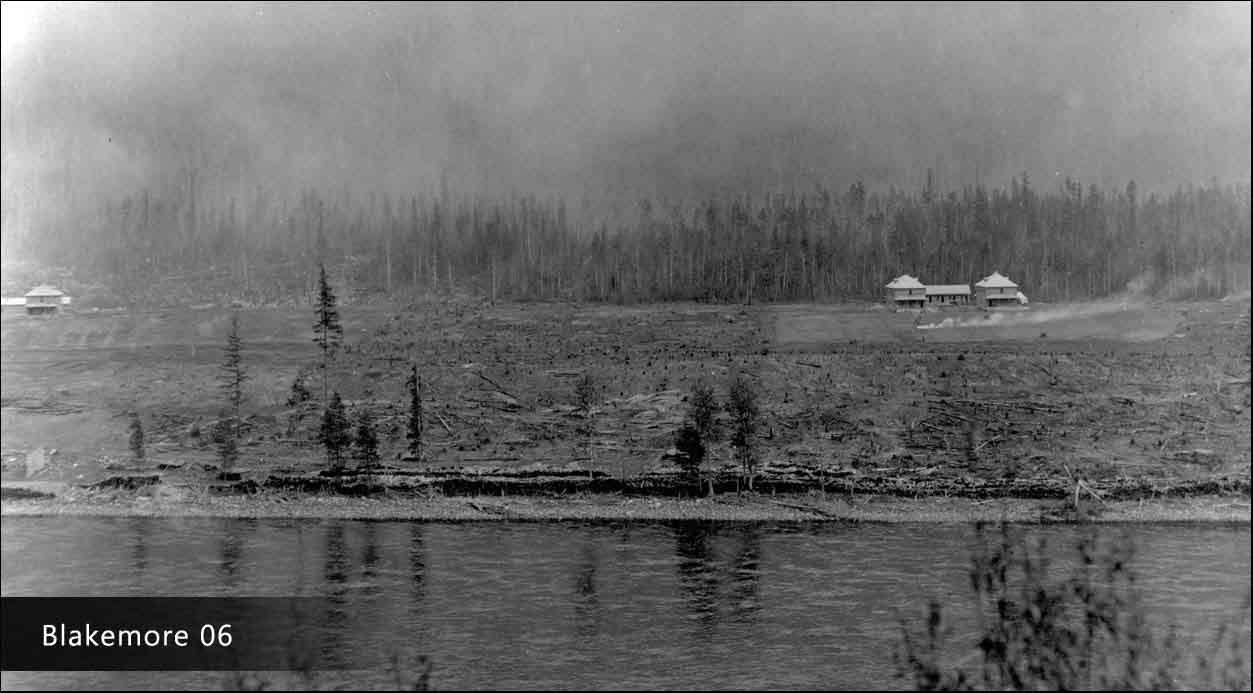
Blakemore 06, the Glade Panorama ...
Peter Verigin purchased 1100 acres of forested land on the eastern side of the Kootenay River in 1910, several miles northwest of Ootischenia, across the river from the Columbia & Kootenay (CPR) railroad. Perceived as potential agricultural land, it was named "Plodorodnoye" or fertile place, by the Doukhobors, while the CPR in the meantime, had named their siding, "Glade" at that point. The progress of Doukhobor settlement at Glade was captured by Allan Lean in a set of 4 individual adjacent images, simulating a panoramic photograph, in that way essentially depicting the full extent of the river bench from the opposite side of the river. The panoramic set is depicted below, along with photo Blakemore 06, which appeared 2nd from left, within the photo set. There is clearly a great deal of "slash and burn" evident here in 1912, although the virgin forest itself is left intact in the distant background.

Curiously this set of four Glade images has a unique local recent history of its own. Copies of these four prints were discovered some time ago in the former Saskatchewan home of Michael William Cazakoff, who was the Vice President of the Doukhobor Christian Community of Universal Brotherhood (CCUB) until the late 1930s. The images were gifted to a nearby descendent in 2016, who brought them in turn to the attention of a Castlegar relative, who turned out to be a member of the Doukhobor Cultural Interpretive Society (CIS). They were offered to this talented and committed group of ladies who accepted them graciously for their safe-keeping and potential exposure to the public.
Taking their volunteer work seriously, they promptly employed Ed Chernoff, a local professional photographer, to have them scanned and digitally stitched into a wide seamless panorama. Large format prints of the panorama were then reproduced in grayscale tones and framed for sale as a means of fund-raising for their society. A large print was presented to the Doukhobor Discovery Centre (museum) where it remains to this day, while the four individual sepia photographs remain on display at the CIS Interpretive Centre at Brilliant, in Castlegar.

This stitched panoramic image apears below. We can estimate the horizontal extent of each individual photo by focusing on the transitional splice points, which are quite apparent. The obvious resulting distortion could have been minimized somewhat with additional "post processing" as demonstrated below, although the historical authenticity of the original four images would have understandably been foremost in mind.
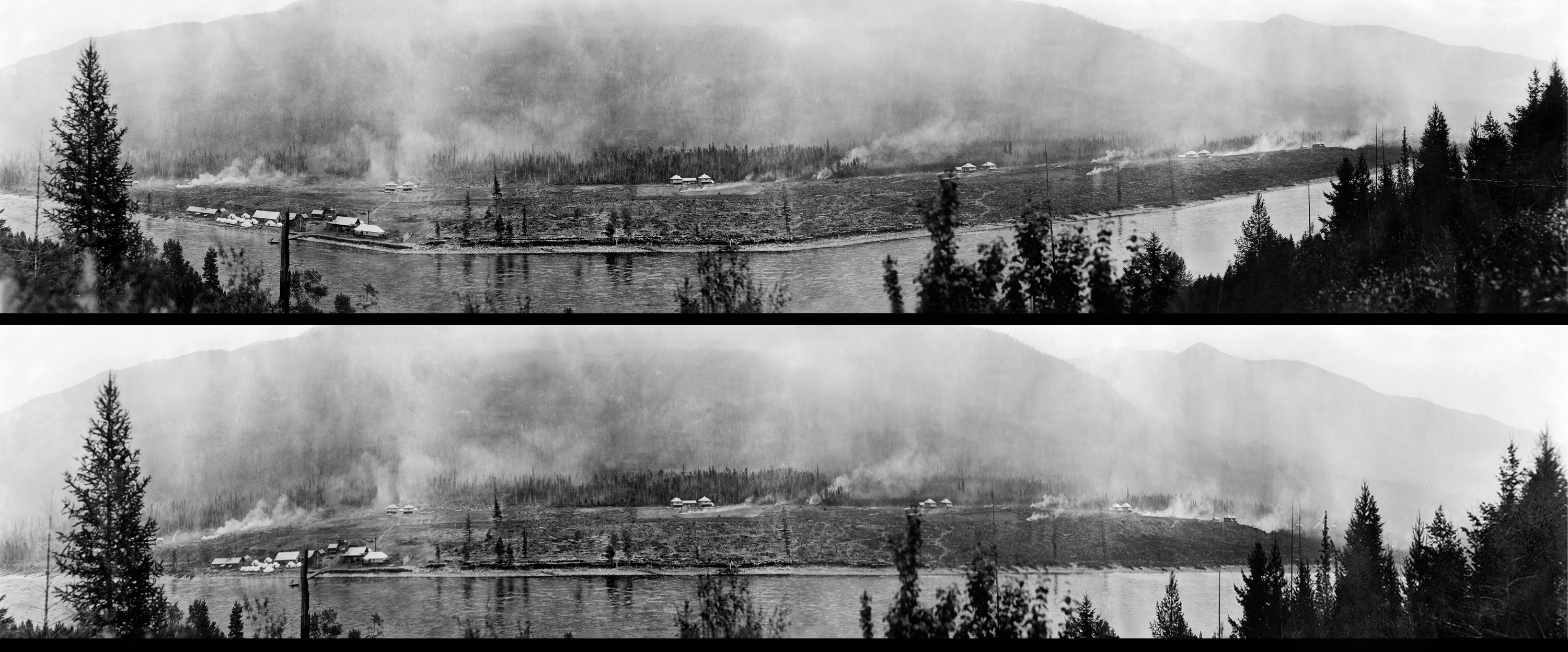
Looking at the panoramas at far left, we can faintly see evidence of the Glade drift ferry and its cable tower, as well as a group of white tents set up to temporarily accommodate early construction workers and their families. This settlement camp is much more evident, looking directly at the first photo of the set, depicted below. And the cable tower is obviously very prominent in the photo at right, surrounded by a group of villagers with Peter V. Verigin.

Blakemore 07-10, the Glade Photographs ...
The Blakemore report refers to the following four images as, "... perhaps, the most interesting of all, as they show every stage of clearing and cultivation, from the hewing-down of the trees and the burning of brush to the clearing-away of all stones and stumps, and ploughing and harrowing, ready for seed."
As they deforested their land, the Glade villagers also constructed a sawmill, accumulating sufficient lumber to build their communal houses, a barn and a blacksmith shop. There is however still work to be done, removing stumps and burning the tangled debris. Six or seven teams of horses are on hand, depicted in Blakemore 09, to do the heavy pulling or lifting, but there is no evidence here of steam tractors or stump-pulling steam-driven donkeys. Photo Blakemore 08 illustrates what appears to be a group of men at work digging a trench, perhaps for the laying of irrigation pipe. Interestingly, there is as yet no evidence of fruit trees or other forms of cultivation to be seen, suggesting that these settlements at Glade were possibly two or three years behind their fellow Ootischenians in that regard.
One figure in these images appears repeatedly in at least three photos, wearing a sheepskin jacket and a straw hat. We can speculate that this may have been Peter V. Verigin himself, serving as a Blakemore tour guide, as the Commissioner and photographer travelled throughout these settlements.

These two images depict early examples of what would become typical Doukhobor communal residential villages throughout British Columbia. And there were 11 of them under construction here simultaneously in 1912, as illustrated in the wide-view panoramic photograph. The Glade villages were, as were all others, typically uniformly spaced at specified distances, leaving sufficient land for each to enable the cultivation of gardens and the construction of necessary outbuildings. The construction details of a typical individual Doukhobor residential "dom" itself, are examined here on the Grand Forks Ozeroff Village webpage. (Link)


An old Glade Village becomes a new Ootischenia Doukhobor museum

Two Glade village communal houses were carefully measured in 1971 by a local Doukhobor engineer and contractor, and a virtual copy of them was reconstructed as a museum in Ootischenia by the newly formed Kootenay Doukhobor Historical Society. The original museum was later renamed the "Doukhobor Discovery Centre", which now ironically, houses many of these same historic Blakemore photographs. The reconstructed village appears below in a contemporary two-part panoramic composite photograph, not unlike the Glade multi-part panorama of 1912. The source photos were taken by this writer several years ago, and stitched together, the composite image ultimately found a place in the current official logo of the D.D.C. museum.
A statue in the foreground of Doukhobor benefactor, Leo Tolstoy, by sculptor Yuri Chernov, overlooks the courtyard of the two museum buildings, seemingly monitoring the steadfastness of modern Doukhobors to their ongoing commitment to pacifism. The statue was presented to the Kootenay Doukhobor Historical Society in Castlegar, BC on July 25-26, 1987 by the Association of Canadians of Russian Descent, compliments of Rodina Society for Cultural Relations, Moscow, former USSR.

The conclusion and aftermath of the Blakemore Report ...
The Commissioner's Report was well-intentioned and conciliatory, calling for patience on the part of the government in dealing with the Doukhobors, who he thought would in time become good citizens.
Listening to the testimony, accusations and objections of local businesses, the Commissioner found most to be insubstantial. On the other hand, he praised the Doukhobors for their remarkable communal accomplishments, and many of their personal and collective attributes:
"When one comes to deal with the personal character, with the habits, the customs, and the practices of the Doukhobors, one has nothing but a pleasant task. Whether in Russia, Saskatchewan, or in British Columbia, they have at all times impressed those who have come into contact with them as being the very essence of kindliness, courtesy, and hospitality."
Nevertheless, he did find the Doukhobor defiance of provincial laws unacceptable, even though it may have been justified in their own minds on religious grounds. Woodcock and Avakumovic summarize his conclusions thus:
"Blakemore ended his report with an extraordinary mixture of recommendations. He suggested that no drastic immediate steps should be taken to force compliance with the education and registration laws, that the government be patient with the people and put pressure only on the leaders, and that, when action had to be taken, fines rather than imprisonment should be imposed. He suggested the appointment of a Doukhobor sub-registrar and of Russian teachers, and a simplification of the curriculum to arouse Doukhobor confidence.
All these were, in the circumstances, excellent recommendations, but Blakemore was moved by his Conservative background to end with a suggestion that, once it was made public, undid all the good his patience and sympathy might otherwise have achieved.
Giving no reasons at all, he expressed the view 'That it is in the best interests of the country that the Order in Council granting exemption from military service should be cancelled.'
As soon as the literate Doukhobors read these words, it seemed to them and all their brethren that their suspicions that the Canadian authorities intended to break their word on this vital question had been justified. More strongly than ever, conscription seemed to them the likely consequence of conformity, and their obstinacy hardened."
The Doukhobors understandably rejected the Commission Report, and government authorities seemingly doubled down and resumed their effort to reign in the "recalcitrant" Doukhobors. The Blakemore photographs were scattered across Canada in various collections over the years, and their source and true significance was essentially forgotten.